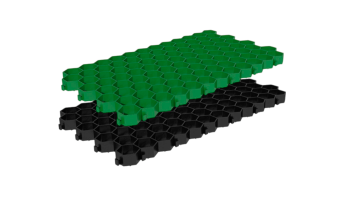
The minimum purchase order quantity for the product is 350.
Soil reinforcement is an important task that needs to be addressed not only by owners of summer cottages and plots, but also by construction organizations and enterprises that lay down railway tracks, arrange the coastal zone of water bodies, expand the building area, etc. The soil is prone to erosion, i.e. destruction and deformation. It shows signs of the influence of water, which washes away the soil, wind, human and animal activities, and the use of machinery. Therefore, additional reinforcement is needed for the formation and preservation of the required landscape.
Soil Protection
To protect the soil from harmful environmental influences, to preserve the slopes and inclinations intact, a variety of means are used, including: lawn grids and geogrids, geotextiles, geomats, geonets.
Geogrids are a common and effective type of soil protection against erosion by rain, weathering, and slope failure. It consists of a cellular structure with strips of geosynthetic fabric that are completely filled with soil, concrete, gravel, or crushed stone.
Geotextile is a material that forms filtering, separating, and reinforcing layers in the soil. This allows for reliable protection of the soil from destruction, prevents mixing of the lower soil layer and the embankment layer, reduces road deformation, and strengthens slopes.
Geomat is a three-dimensional water-permeable structure made of polymer or natural fibers interconnected by thermal, mechanical, and other methods. It protects the topsoil and anchors plant roots, thus forming a vegetation mat that is resistant to rainwater flows and soil erosion. It is resistant to UV radiation, microorganism influence, various chemical impacts, and is non-toxic.
Geonets are water-permeable flat synthetic structures that resemble a mesh grid, with elements forming a grid connected by nodes. These elements are intertwined, compressed, or molded. They are typically used to ensure stability, create anti-erosion plant cover on slopes, reinforce, divide layers of road surfaces. They can be made of polyester, polyethylene, polyamide, polypropylene, polyester, or fiberglass.
Soil reinforcement with lawn grids.
Lawn grids perform a variety of functions and have become indispensable in landscaping areas where soil reinforcement is needed, protecting the root system of lawn plants, and preventing soil erosion. Lawn grids effectively protect the grass layer and its root system from being crushed by bicycles, pedestrians, cars, making them widely used for eco-parking, barbecue areas, lawns, and glades in parks and squares, and outdoor event venues. They are usually made of plastic and concrete. Plastic lawn grids can withstand a maximum load of 20 tons/m2 and can be used in areas where light vehicles drive.
In areas where heavy vehicles drive, concrete lawn grids are successfully used to preserve green areas on access roads to shops and markets, in terminal areas, warehouses, machine parks, etc.